All three go live on a Marker the same way, all three get a public link, and all three count as one against your plan's allowance. The difference is how much page there is between the tap and the outcome.
| An Experience | An Action | A Redirect | |
|---|---|---|---|
| What it is | A page of blocks you arrange | One block, one outcome, on its own page | Two fields and a destination |
| Time to build | Ten minutes upward | About a minute | Under a minute |
| Visitor sees | Your content, as long or short as you make it | One card, centred, nothing else | Somebody else's page: yours never renders |
| Editable later | Everything | The block's fields | The destination only |
| Counts against your plan | One slot | One slot | One slot |
Reach for an Action when there is exactly one outcome
The product's own line is “one tap, one outcome”, and the test is whether a second thing on the page would be a distraction. A guest standing at a nightstand wanting the Wi-Fi password does not want a photo gallery above it.
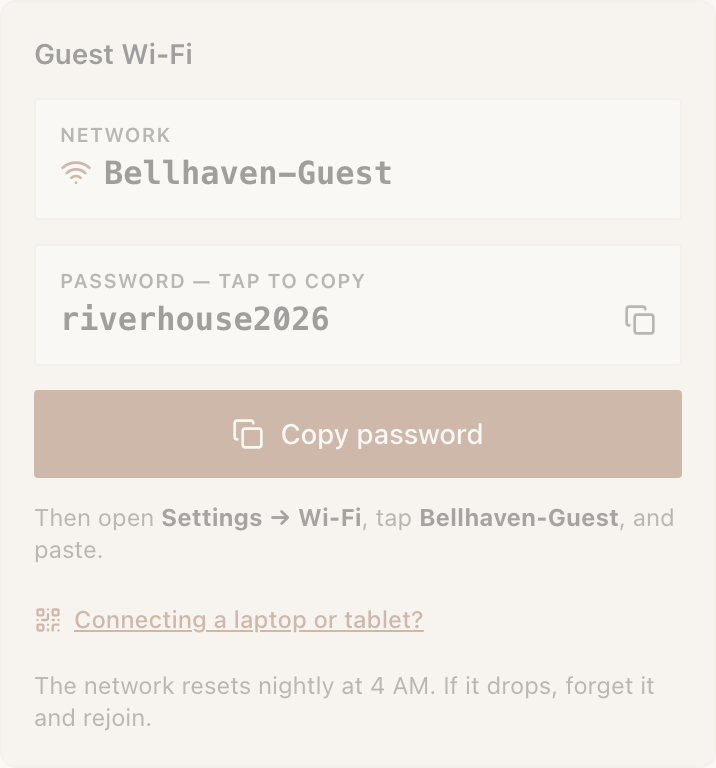
There are 17 Action types. Seven are free: Guest Wi-Fi, Call, Directions, File, Action Hub, Donate and Pay. The rest arrive with Starter, Growth and Enterprise. Every one of them is also available as a block inside a full Experience, using the identical editor and rendering identically, so nothing is lost by starting with an Action and folding it into a page later.
Live example · The Bellhaven Hotel
Open full sizeReach for a Redirect when the page already exists
A Redirect sends the visitor straight to a link you already have: a ticketing site, a booking engine, a menu PDF that somebody else maintains. NearField never renders anything of its own, which means no Inclusion Bar, no blocks and no translation on the destination.
The reason to use one at all is the Marker: a Redirect gives an existing web page a physical Marker, an editable destination and scan analytics it did not have before. Swap the destination for next season's booking page and the Marker on the wall follows.
Reach for an Experience when there is more than one thing to say
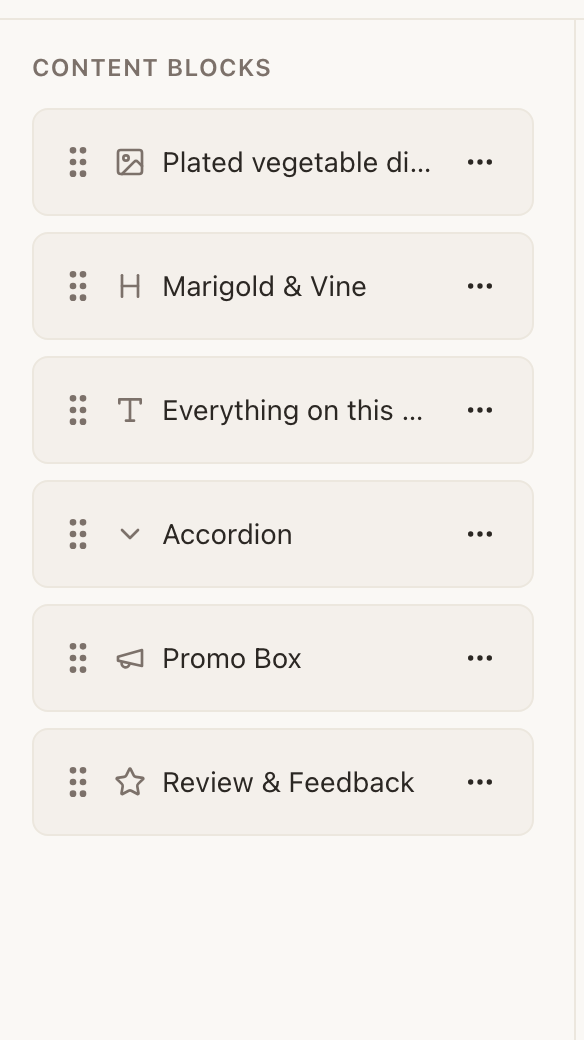
Anything with a story, a list, a set of hours, a gallery, or a question you want answered is an Experience. It is also the only one of the three that can hold Memory blocks and change what it shows on a return visit. See what Memory remembers.
Example
Ridgewood Museum of Natural History
Ridgewood uses all three. Each gallery gets an Experience with a photo, the curator's notes, an audio track and a rating question. The lift lobby gets an Action: Directions, straight to the accessible entrance. The membership Marker gets a Redirect to the existing donation page their finance office already reconciles against, because rebuilding that page in NearField would have created a second thing to keep in step.
Changing your mind
You cannot convert one into another. What you can do costs nothing: build the replacement, then relink the Marker to it. The Marker does not care which of the three it points at, and the old one can be deleted afterwards to open up the slot.
Does an Action really use up an Experience slot?
Yes. Every Action and every Redirect is stored as an Experience, so a plan with three Experiences means three of anything at all. This is the most common surprise on the free plan, which has one live slot once the trial is over.
Can an Action live inside an Experience?
That is the normal case. Add Block includes every Action type your plan allows, and the block behaves exactly as the standalone version does.
Do Redirects get stats?
You get the tap and the scan, since those happen on our side. What the visitor does after they land on somebody else's page is invisible to us.
Which one should a first-timer make?
An Experience. It is the one that teaches you the builder, and the free plan's single live slot is better spent on the thing with more in it.