Guide · RV parks
NFC for RV Parks: Replace Paper Handouts With a Tap
Stop reprinting laminated signs every season. Markers at the bathhouse, welcome kiosk and camp store give guests multilingual answers without an app.
Running an RV park means answering the same questions hundreds of times a season. When does the bathhouse open? What's the Wi-Fi password? Are there quiet hours? Can guests order firewood? Is the dump station by site 40 or site 80?
The traditional answer (a laminated welcome sheet, a bulletin board near the office, a note on the site post) degrades faster than you'd like. Laminate bubbles in summer humidity. Signs fade in direct sun. A policy change means reprinting everything, and outdated versions keep floating around for months after.
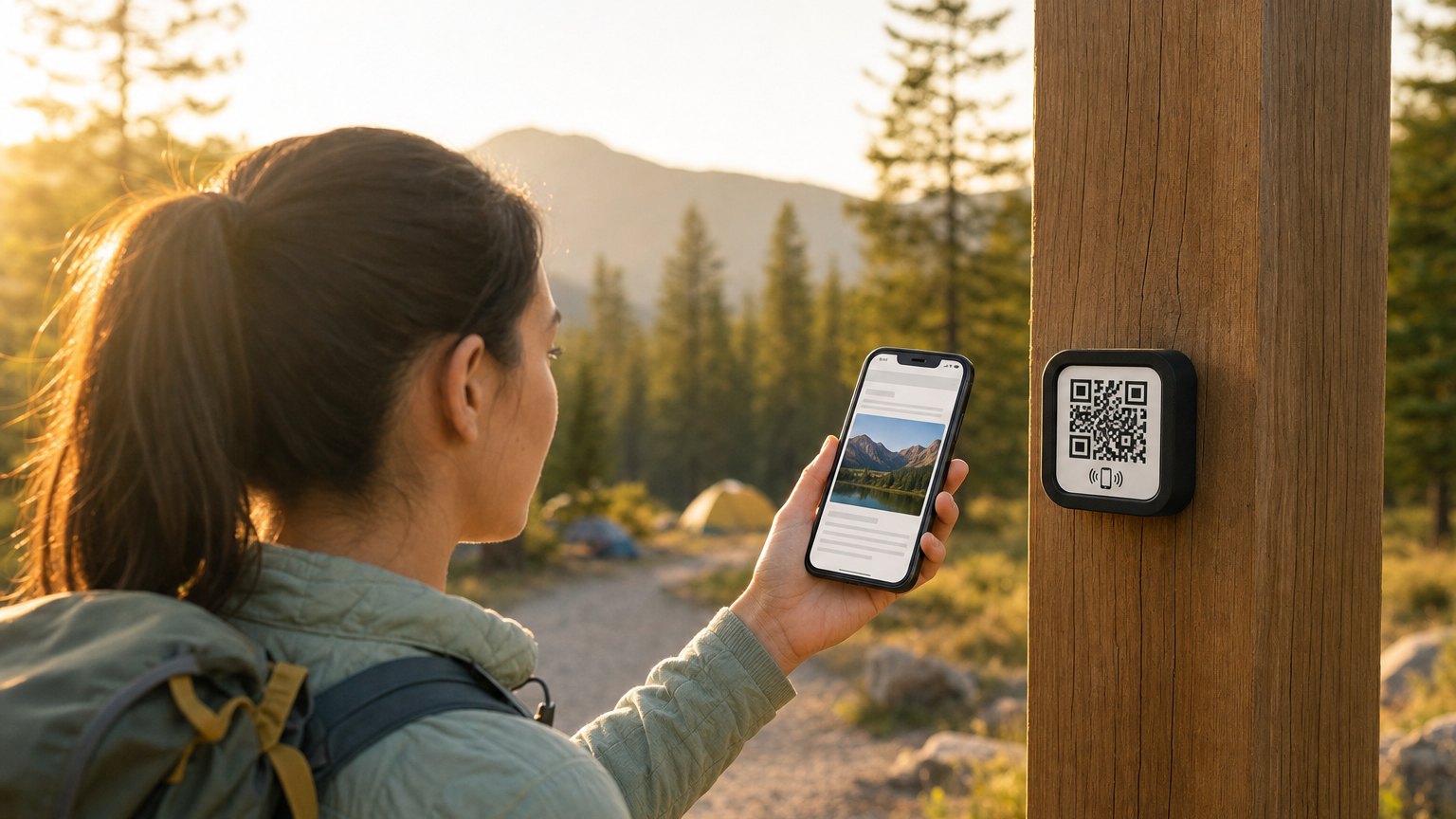
The alternative is to place NFC Markers at specific physical spots instead: the bathhouse entrance, the welcome kiosk, the camp store door. A guest taps the Marker with their phone (no app, no QR aim, no download) and a mobile-friendly page opens instantly with everything that location needs to communicate. When the operator updates the content, every Marker updates automatically. Nothing gets reprinted.
Why This Works for Campgrounds
The outdoor hospitality industry has a specific information problem: guests arrive with questions, staff can't be everywhere, and printed materials deteriorate faster than in any indoor environment. Over 6 million campers and RVers vacation in Florida every year (Florida RV Park & Campground Association), and roughly 90 percent of U.S. RV parks are owner-operated with fewer than five locations, small operations where every staff hour matters and printing costs accumulate season after season.
An NFC Marker is three inches square, UV-resistant and rated for outdoor mounting, and it goes anywhere a sign would. Guests tap it with an iPhone or Android phone; the phone opens a mobile page in the browser with no download required. (iPhones since 2018 and most Android phones since 2015 support NFC natively.) The operator manages all content from a web browser. The Markers never need replacing.
Where Campgrounds Are Placing Markers
Welcome kiosk or registration area
The first tap a new guest makes covers full orientation: site map, Wi-Fi password, check-in and checkout times, quiet hours, pet policy, fire rules, emergency contacts, and nearby fuel and grocery options. Staff hand a single card pointing to the kiosk Marker, or guests tap independently at a self-check-in post, instead of walking through the same five-minute briefing on every arrival.
Bathhouse entrance
The bathhouse is the highest-traffic shared facility on most campgrounds. A Marker at the door handles current hours (including seasonal schedule changes), maintenance windows, and whether showers use tokens. Guests stop making office trips to ask; staff stop fielding the same call before 7am.
Individual campsite posts
Site-specific information has no good permanent home: hookup specs (30 amp vs. 50 amp), water pressure notes, instructions for the fire ring, and a one-tap link to report a maintenance issue. A Marker on the campsite post gives guests that detail without requiring it to be printed and re-laminated at every site after every update.
Camp store or laundry room
Store hours, payment methods, what's currently stocked, and where to get firewood. A laundry Marker can include machine instructions, coin requirements, and estimated cycle times, small pieces of information that prevent unnecessary trips to the office during peak check-in windows.
Pool, activity pavilion, or dog park
Weekend event schedule, reservation booking links, pool rules. During high season, this becomes a real-time notice board: the operator updates the weekend schedule once, and every guest who taps the pavilion Marker that afternoon sees the current version.
The Update Problem, Solved
The biggest friction with physical campground signage is the update cycle. When quiet hours shift seasonally, every posted sign needs to change. When the camp store closes early on Sundays, every schedule is now wrong until someone reprints and rehangss it. When a new manager inherits a property, they spend their first weeks replacing outdated laminated sheets that previous staff never got around to pulling.
With NearField, one change in your dashboard shows up immediately on every Marker pointing to that page. No reprint, no re-laminate, no update loop across 30 sites. A 50-site park with Markers at the welcome kiosk, two bathhouses, the pool, and the camp store has five pages to maintain, and none of them on paper.
Multilingual Guests Don't Need a Separate Sign
Every NearField Experience includes the Inclusion Bar: a set of controls at the bottom of every page that lets guests translate content into 20+ languages with one tap, have the page read aloud, switch to high-contrast display, or adjust text size. That's on by default, on every Experience, at no extra cost.
For a Florida campground with international visitors (and Florida's RV visitor base includes substantial international traffic from Canada, Germany, the UK, and Latin America), this matters practically. A German couple on a cross-country trip, a Spanish-speaking family in the next site, and a domestic guest with low vision all tap the same bathhouse Marker and get a page that works for them.
No printed sign handles that. No bulletin board does either.
What This Looks Like as a Line Item
A small RV park (20-30 sites) typically places Markers at:
- 1 welcome kiosk or self-check-in post
- 1-2 bathhouses
- 1 camp store or laundry room
- 1 pool or activity pavilion
- Site posts (optional; most operators add these in a second phase)
That's 5-8 Markers to cover the core touchpoints. A Growth plan at $39/month covers up to 10 live Experiences and 30 Markers; the Intro 3-Pack of Markers is $49, and additional Markers are $29 each, with shipping included. A park with 20 Markers covering every shared touchpoint and campsite cluster would spend about $542 in hardware upfront, then $39/month, with no printing costs going forward.
Compared to reprinting and re-laminating an 80-site campground's full sign set each season, the math is straightforward.
Getting Started
The fastest way to understand what this looks like on your property is to hold one in your hand. NearField will preload a Marker for your welcome kiosk or bathhouse entrance, built with your actual park information, and mail it to you, on us. No card needed. Request a preloaded Marker →
If you're deciding between NFC and QR stickers for outdoor signage, the NFC vs. QR guide covers the practical durability and usability differences for permanent outdoor installations.
Ready to build?
Try it on one spot first
Build the page free, with no card needed. When it reads right, three Markers are $49 with shipping included. Your 14-day trial starts when your page goes live.

Related guides
More for hospitality: QR code & NFC for hotels, restaurants, and vacation rentals →