Guide · Breweries
NFC for brewery taprooms — a tap list that's never out of date
A taproom's information problem is that the information changes faster than anything you can print. A keg blows at seven on a Friday. A one-off pilot batch goes on at four. The chalkboard is accurate for about as long as it takes someone to walk from the board to a stool.
The chalkboard problem
Most taprooms run three information systems at once and none of them agree: a chalkboard that's rewritten when someone has a free hand, a website tap list that updates on a good week, and whatever your bartender remembers. Guests notice. The most common question in a taproom is still "what's this one like?" — asked about a beer whose description is written on a board eight feet behind them in handwriting they can't read from a stool.
The stakes are higher than they look, because the beer that needs description is almost never the flagship. It's the sour nobody's heard of, the pilot batch, the barrel-aged release with four hundred bottles. Those are the pours with the best margin and the shortest window, and they're the ones a rushed bartender has the least time to sell.
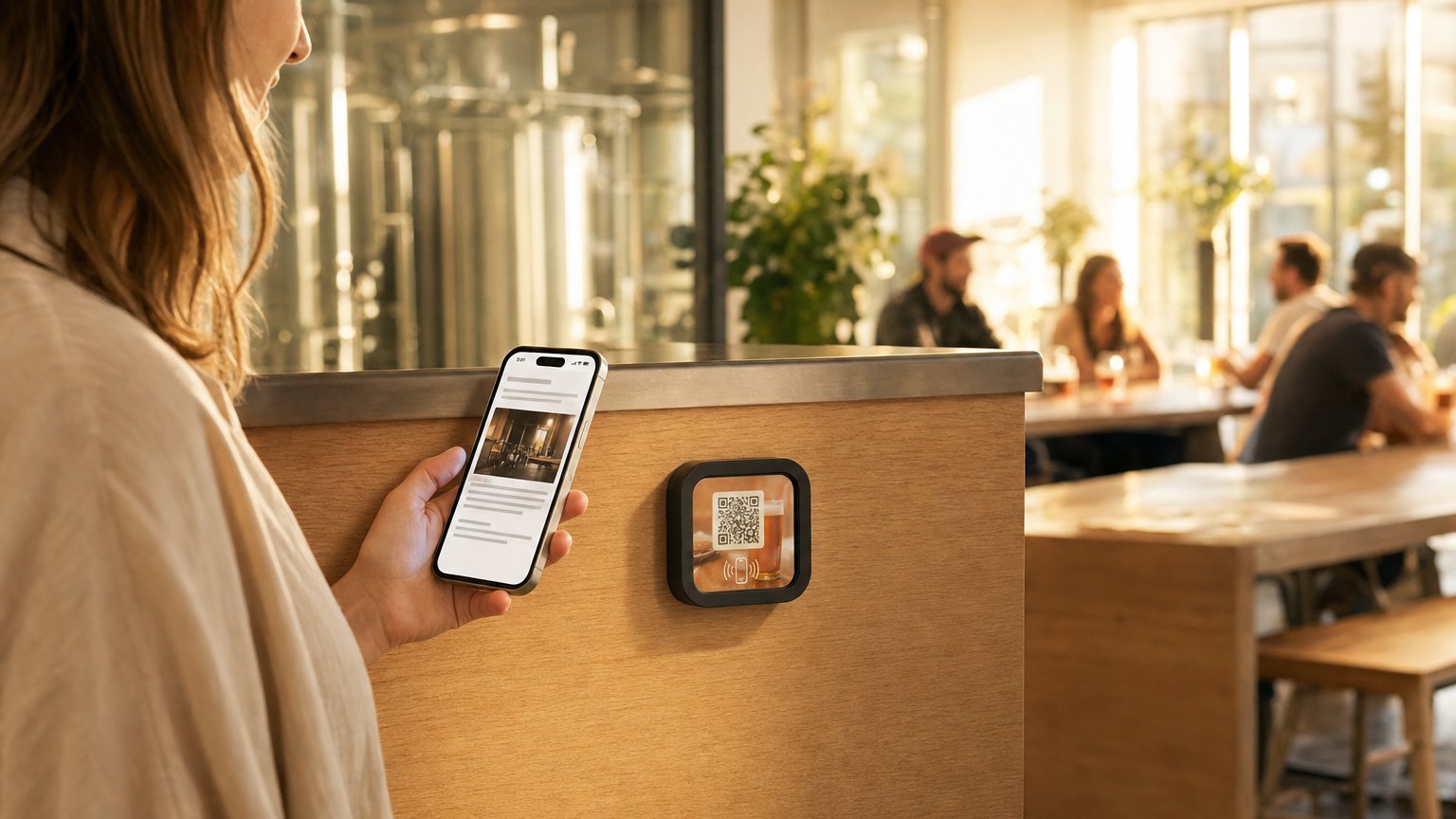
A NearField Marker on the bar or the table gives every guest the full list, the notes, and the story, at the moment they're deciding what to order next.
What goes on a taproom Marker
The live tap list. Every pour with style, ABV, IBU where it matters, a real description written like a person talking, and a pour-size and price grid. When a keg blows, you change one line and every Marker in the room is current.
The story behind the beer. Where the hops came from, what the brewer was chasing, why the barrel mattered, how long it sat. This is the part that turns a four-ounce taster into a four-pack to go, and it's the first thing cut when the bar is three deep.
What's rare right now. A short, honest "pouring today, probably gone tomorrow" section. Scarcity that's actually true is the most effective merchandising a taproom has.
To-go and the release list. Crowlers, four-packs, and bottle pricing, plus a sign-up for release announcements. A guest holding a beer they love is the single best moment to ask them to hear about the next one.
Food, or who's parked outside. If you run a kitchen, the menu. If you run a rotating food truck, this week's truck and its hours — the question your bartender answers most often after "what's this one like?"
Ready to try it?
Build your first taproom Experience free. No credit card required.
Build a taproom Experience freeWhere the Markers go
The end of the bar and the communal tables. The highest-traffic placements. Guests tap while they're deciding on the next round rather than waiting for a gap in the bartender's attention.
Along the brewhouse glass. Nearly every taproom has a window onto the tanks, and nearly every guest looks through it without knowing what they're looking at. A Marker at the glass turns that into a self-guided tour — what a mash tun does, what's fermenting in that vessel right now, why the bright tanks are cold. This is the single most under-used placement in the category, and it costs a brewer nothing in floor time.
The patio and the beer garden. Outdoor placements are where printed signage dies fastest — sun, rain, and wind take out an adhesive QR label in a season. A moulded Marker survives it. The differences between NFC and printed QR are covered in detail here.
The to-go cooler. A Marker on the cooler door answers the question guests won't ask a busy bartender: what's in the four-packs, what's cellarable, and what's only here this week.
Reviews and check-ins, asked at the right moment
Untappd check-ins and Google reviews both suffer from the same problem: the ask happens at the wrong time. A card on the table asks before the guest has an opinion. An email the next morning asks after they've stopped caring.
A Marker asks in the middle — the guest taps to read about the beer they're drinking, and the check-in or review path is sitting right there underneath the description, at the exact moment they've formed a view and are still holding the glass. Taprooms that put the review action inside the beer description rather than at the end of the visit see the difference immediately.
Because the Experience carries context forward, a returning guest can be shown what's new since their last visit instead of the same welcome a first-timer gets. And Experiences render in 20 languages, which matters for taprooms in tourist corridors and near convention business.
Start with an Action
A full taproom Experience is the destination. These three solve a Friday-night problem on their own.
Review & Feedback
Asked while they're still holding the glass.
Try the live demoLead Capture
The release list, signed up from the bar.
Try the live demoDirections
Sends the crowd to tonight's food truck.
Try the live demoEach one goes live in under a minute, and any Action converts into the full Experience described here in one tap — the same link and Markers keep working. See all 17 Actions.
Ready to build?
Build your first taproom tile
The brewery template includes a live tap list, the story behind each pour, a what's-rare section, to-go pricing, and a review or check-in action. Start with the beers your bartenders explain most often.